Research & Invention
Z-Ratio
A second-by-second unified metric of sleep and wakefulness — original research by Claude Albertario.
A second-by-second unified metric of sleep and wakefulness — original research by Claude Albertario.
Traditional sleep medicine describes the night in discrete stages — Wake, N1, N2, N3, and REM — scored in 30-second epochs according to the rules established in the AASM Scoring Manual. While epoch-based staging has served clinicians well for decades, it necessarily collapses a continuous biological process into a series of categorical labels. A great deal of information lives between those labels.
Z-ratio emerged from a straightforward observation: the EEG signal during sleep is not static within an epoch. A 30-second window scored as N2 may contain moments that are neurologically closer to wakefulness or to deep sleep than the epoch label alone can convey. Standard staging tells us what stage; z-ratio attempts to describe where on the continuum a person actually is, second by second.
Z-ratio is a continuous, quantitative measure derived from the polysomnographic EEG signal. Rather than waiting for a 30-second epoch to accumulate enough data for categorical classification, z-ratio produces a score for every second of the recording — creating a waveform of its own that tracks the real-time trajectory of sleep and wake.
The metric unifies the sleep/wake continuum into a single number that rises and falls in response to the underlying neurophysiology. Higher values correspond to wakefulness and lighter sleep; lower values reflect deeper, more consolidated sleep states. The resulting trace provides a new lens through which to examine the structure of a night's sleep — one that complements, rather than replaces, conventional hypnogram staging.
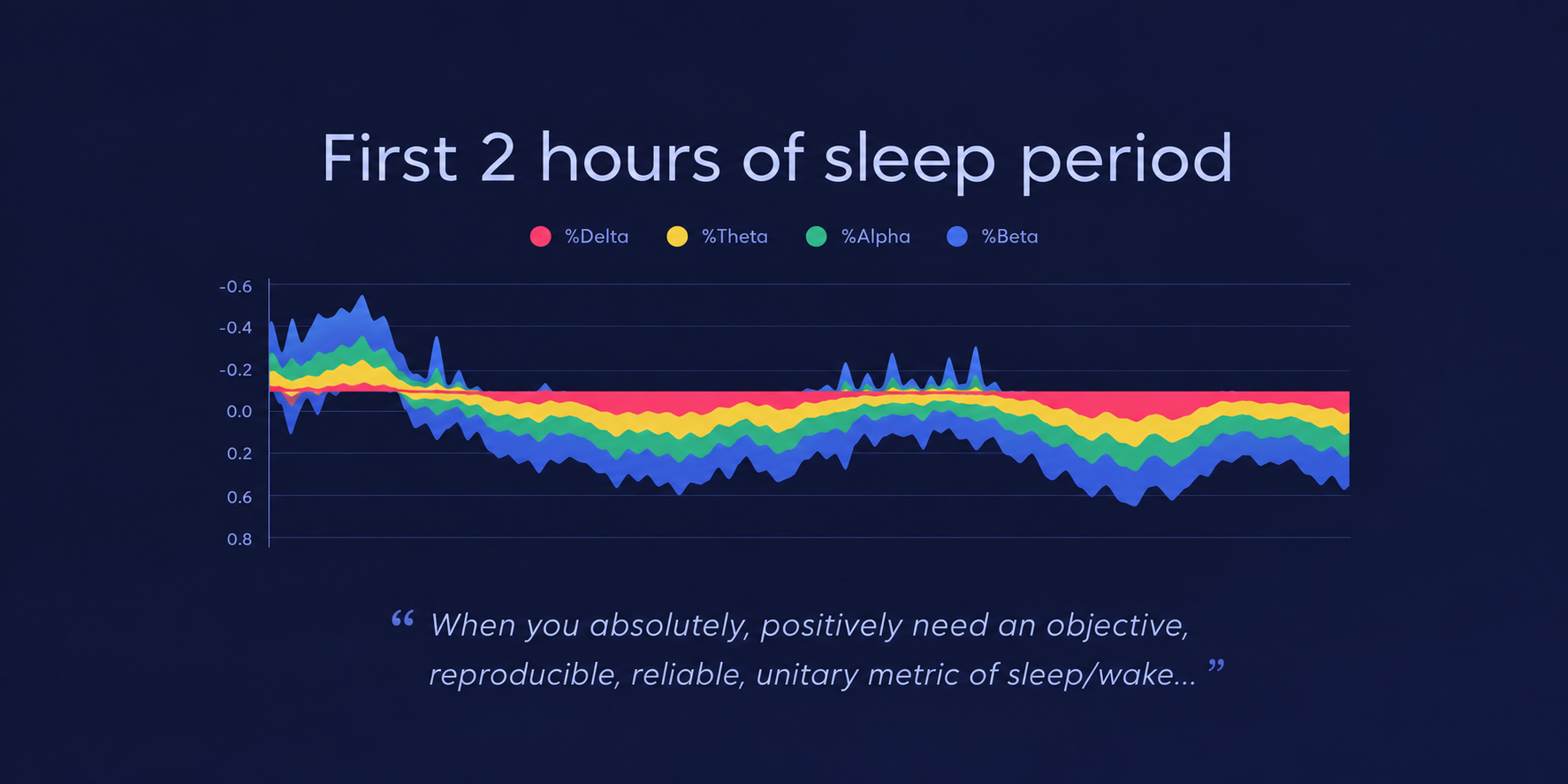
The conventional hypnogram offers a useful summary of a night's sleep, but it can mask the degree of sleep fragmentation, the quality of transitions between stages, and the stability of sleep within a given epoch. Z-ratio addresses this limitation by providing a continuous representation of the sleep/wake state — one that can reveal micro-arousals, transitional patterns, and subtle instabilities that standard staging alone would not capture.
"The hypnogram gives you the chapter headings. Z-ratio lets you read between the lines."
Potential applications include the characterization of sleep quality beyond standard metrics, the evaluation of treatment effects in conditions like OSA, and the development of more nuanced outcome measures for clinical trials in sleep medicine.
Berry RB, Albertario CL, Harding SM, et al; for the American Academy of Sleep Medicine. The AASM Manual for the Scoring of Sleep and Associated Events: Rules, Terminology and Technical Specifications. Version 2.5. Darien, IL: American Academy of Sleep Medicine; 2018.
Albertario C, Zendell S, Hertz G, Maberino M, Feinsilver S. Comparisons of a Frequency-Based Analysis of EEG (Z-Ratio) and Visual Scoring on the MSLT. Sleep 1995;18(10):836–843.
Albertario C, Maberino M. Quantification of Sleep/Wake in 2 Seconds of EEG. Journal of Polysomnographic Technologists, December 1991.
Editorial Board contributor: Butkov N, Lee-Chiong T. Fundamentals of Sleep Technology, 1st Edition. 2006. Chapter: "Recognizing and Scoring Recorded Events."
Albertario C, Zendell S, Hertz G, Maberino M, Feinsilver SH. Comparisons of Z-ratio and standard scoring techniques for sleep/wake determination on the MSLT. Sleep Research 1992;21:328.
Albertario C, Hertz G, Feinsilver SH. Computerized quantification of sleep and wakefulness in the EEG. Sleep Research 1991:20A;484. Presented at the Founding Congress of the World Federation of Sleep Research Societies, Cannes, France 1991.
Albertario C, Maberino M. Quantification of Sleep/Wake in 2 seconds of EEG. Journal of Polysomnographic Technologists, December 1991.
2005 — "Zomnography: An Online Metric of Sleep/Wake Using the Unitary Measure Z-Ratio." World Association of Sleep Medicine, Berlin, Germany.
1996 — "Z-Ratio as a means to quantifying sleep." Computer Applications Special Interest Group workshop, National APT Meeting, Washington, DC.
1994 — "Comparisons of Z-ratio and standard scoring techniques for sleep/wake determination on the MSLT." National APT Meeting, Boston, MA.
1992 — "Computerized quantification of sleep and wakefulness in the EEG." National APSS Meeting, Phoenix, AZ.
For further information on z-ratio, visit www.zratio.com or reach out directly.